Welcome
to NAPO
The
National Association of Police Organizations (NAPO) is a coalition
of police unions and associations from across the United States
that serves to advance the interests of America's law enforcement
officers through legislative and legal advocacy, political
action and education.
Founded
in 1978, NAPO is now the strongest unified voice supporting
law enforcement officers in the United States. NAPO represents
more than 2,000 police unions and associations, 238,000 sworn
law enforcement officers, 11,000 retired officers and more
than 100,000 citizens who share a common dedication to fair
and effective crime control and law enforcement.
NAPO
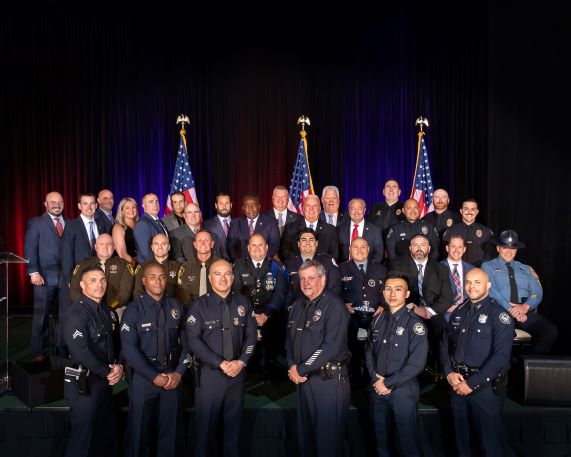
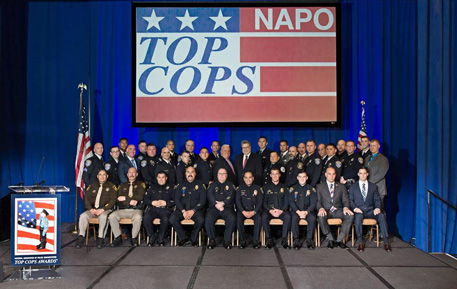
Announces 2008 TOP COPS
Award® Winners
NAPO
ACHIEVES VICTORY AT U.S. SUPREME COURT
On February
25, 2008,
the U.S. Supreme Court issued two decisions in favor of the
National Association of Police Organizations ("NAPO") and
law enforcement officers across the United States. First, the Court granted a motion filed by NAPO in November to allow the group to participate in the
case as an "amicus curiae" or "friend of the
court". The role of an amicus curiae is to make
available to the Court the benefit of NAPO's extensive knowledge and experience
in the sphere of law enforcement, particularly as it regards
the challenges and dangers confronted by rank and file officers.
NO OTHER POLICE GROUP WAS GRANTED PERMISSION BY THE
COURT TO PARTICIPATE.
Second, the Court also granted a petition made by the State
of Arizona
and supported by NAPO, to review a decision of the Arizona State Supreme
Court that, if left unchallenged, could significantly endanger
the safety of officers everywhere. In the case,
Tucson officers conducted a routine "Belton" search of
the interior of a vehicle following the lawful arrest of the
occupant. On appeal, the state supreme court held for
the first time that once the officers had placed the occupant
under arrest and secured him, they had lost the right to search
the vehicle they had just removed him from. This
decision contradicts well-settled law concerning the right
of officers to search the passenger compartments of vehicles
to locate and preserve evidence, to safekeep items, and
most importantly, to protect themselves. If left to
stand, the Arizona
court's decision would force officers to try to search
a vehicle when the accused is still occupying it, or
to give up their legitimate right to protect their own
safety by being unable to search once an arrest has been made.
The next step in this process at the U.S. Supreme Court level,
now that that Court has agreed to take jurisdiction, will
be for both parties to file briefs on the merits, and
to set the case for oral argument. NAPO
will keep all members informed of the progress of the case.
The case is titled "Arizona vs. Gant" U.S. Supreme
Court Case No. 07-542. NAPO's brief was
authored by Devallis Rutledge of the Los Angeles County D.A.'s Office, and Bill Johnson, NAPO's executive director and general counsel.
NAPO
AGAIN SOLE POLICE GROUP TO TESTIFY BEFORE U.S. SENATE
Anthony Wieners, NAPO Executive Board Member
and President of the New Jersey State PBA, Testifies Before
Senate Judiciary Subcommittee
On Wednesday, February, 27, 2008, Detective Anthony Wieners,
NAPO Executive Board Member and President of the New Jersey
State Policemen’s Benevolent Association, testified before
the Senate Judiciary Subcommittee on Crime and Drugs on “Supporting
the Front Line in the Fight Against Crime: Restoring Federal
Funding for State and Local Law Enforcement.” The hearing
consisted of three panels of witnesses. Senators Tom Harkin
(D-IA) and Saxby Chambliss (R-GA) and Mark Eply, senior counsel
to the deputy attorney general of the U.S. Department of Justice,
made up the first two panels. Detective Wieners testified
alongside Police Chief Jeffrey Horvath of Dover, Delaware, and Philadelphia, Pennsylvania Police Commissioner Charles Ramsay
on the third panel. Detective Wieners was the only representative
of rank-and-file law enforcement asked to testify at the hearing.
This is the third time in ten months that the U.S. Congress
has turned to NAPO to be the sole rank-and-file law enforcement
organization to provide testimony regarding the role of the
federal government in helping communities prevent and respond
to violent crime, as well as the need for collective bargaining
for America’s law enforcement officers.
Detective Wieners addressed three issues in his testimony that
are of increasing concern to NAPO and law enforcement: the
decrease in funding for vital Department of Justice state
and local law enforcement assistance programs witnessed over
the past several years; the additional duties taken on by
local law enforcement agencies in the post-9/11 era; and finally,
the recent increase in crime rates experienced by communities
nationwide. He called on the federal government to reverse
the downward spiral in support of state and local law enforcement
grant programs and to recognize the important impact having
more police on the streets has on crime.
Click here
for a complete copy of Detective Wieners’ submitted testimony.
NAPO
SOLE LAW ENFORCEMENT ORGANIZATION TO TESTIFY BEFORE CONGRESS
ON ISSUES OF COLLECTIVE BARGAINING AND FEDERAL ASSISTANCE
FOR STATE AND LOCAL LAW ENFORCEMENT
NAPO
PRESIDENT TOM
NEE TESTIFIES BEFORE SENATE JUDICIARY SUBCOMMITTEE
During
this session of Congress, NAPO President Tom Nee testified before on the Senate
Judiciary Subcommittee on Crime and Drugs regarding the role
of the federal government in helping communities prevent and
respond to violent crime. Mr. Nee addressed three issues in his testimony
that are of increasing concern to NAPO and law enforcement:
the decrease in funding for vital Department of Justice state
and local law enforcement assistance programs witnessed over
the past several years; the additional duties taken on by
local law enforcement agencies in the post-9/11 era; and finally,
the recent increase in crime rates experienced by communities
nationwide. He called
on the federal government to reverse the downward spiral in
support of state and local law enforcement grant programs
and to recognize the important impact having more police on
the streets has on crime.
NAPO was the sole law enforcement organization invited to speak on behalf of
rank-and-file enforcement at this hearing.
[click
here for Tom Nee's testimony in pdf format]
PAUL NUNZIATO, PORT AUTHORITY
PBA, TESTIFIES
BEFORE CONGRESS ON COLLECTIVE BARGAINING
Also
during this session, Paul Nunziato,
Vice-President of the Port Authority Police Benevolent Association,
testified before the House Subcommittee on Health, Employment,
Labor and Pensions on “Ensuring Collective Bargaining Rights
for First Responders: H.R. 980, the Public Safety Employer-Employee
Cooperation Act”. Specifically, Mr. Nunziato
addressed the issue of collective bargaining and homeland
security efforts, using his experience, and that of his fellow
officers with the Port Authority Police Department, in responding
to the September 11, 2001 terrorist attacks.
Congress needs to understand that collective bargaining
rights are crucial to the protection of the health and welfare
of public safety officers and their families, and that these
rights in no way represent a danger to national security.
NAPO was the only law enforcement organization asked to provide a witness to
be the voice for law enforcement at this hearing.
[click
here for Paul Nunziato's testimony in pdf format]
Within a three week period,
NAPO
was honored twice to be the sole law enforcement organization
to testify before Congress on behalf of the rank and file
law enforcement community concerning the issues of federal
assistance for state and local law enforcement and collective
bargaining. |